
Section 44AD Explained: When Does a Firm Actually Need a Tax Audit?
For small and mid-sized partnership firms, Section 44AD of the Income-tax Act is one of the most useful — and most misunderstood — compliance provisions available. It lets eligible firms declare a flat presumptive profit and skip the burden of maintaining detailed books and undergoing a tax audit. But the moment a firm dips in and out of this scheme, the audit rules get confusing fast.
This post breaks down exactly when Section 44AB (tax audit) gets triggered for a firm using — or not using — Section 44AD, based on real scenario mapping.
The Basics of Section 44AD
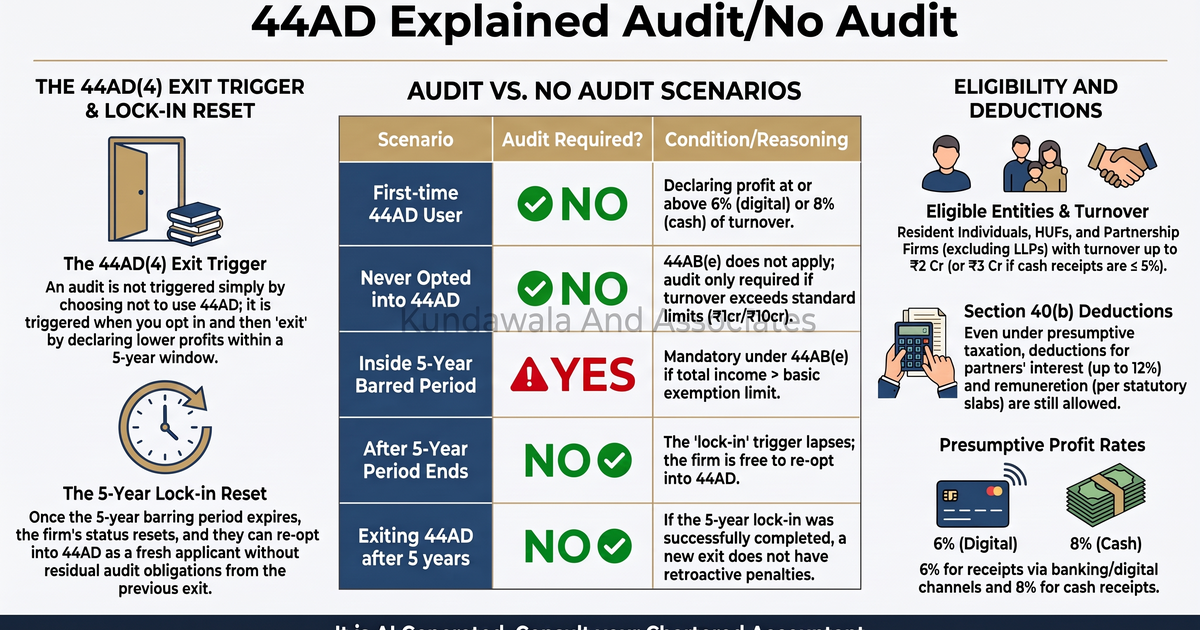
Section 44AD is available to resident individuals, HUFs, and partnership firms (excluding LLPs), for eligible businesses with turnover up to ₹2 crore (extendable to ₹3 crore where cash receipts don't exceed 5% of total receipts). Firms opting in must declare profit at a minimum of:
- 6% of turnover received through banking/digital channels
- 8% of turnover received in cash
Once this presumptive income is declared, Sections 30–38 (regular business deductions) are deemed already factored in — no separate claim is allowed for those. However, Section 40(b) deductions for partners' interest and remuneration remain available even under 44AD, since 40(b) sits outside the deemed-deduction block.
The Real Trigger for Audit: It's Not About Turnover Alone
Many assume a small-turnover firm is automatically safe from audit. That's true only up to a point. Audit under Section 44AB can be triggered two separate ways:
- Turnover-based (44AB(a)) — mandatory once turnover crosses ₹1 crore (or ₹10 crore, if cash transactions are within 5%).
- 44AD exit-based (44AB(e)) — this is the one that catches people off guard. It applies only if both of the following are true in a given year:
- The firm had declared profit under 44AD in any of the preceding 5 years, and has now exited (declared below the presumptive rate, or not opted for 44AD at all) — this is the Section 44AD(4) trigger, and
- The firm's total income exceeds the basic exemption limit in that year.
If either condition fails, audit under this route does not apply — regardless of turnover.
Scenario-by-Scenario Breakdown
ScenarioAudit Required?Why
First-time 44AD user, declaring profit at/above 6%/8%
No
Full compliance with 44AD; no exit event exists
Firm has never opted into 44AD at all
No
44AD(4) has nothing to trigger from — there's no prior presumptive declaration to "exit"
Firm is inside the 5-year barred period after an earlier 44AD exit, and total income exceeds the exemption limit
Yes
Both conditions of 44AB(e) are satisfied
The 5-year lock-in period has ended
No
The exit trigger lapses; the firm can freely re-opt into 44AD as a fresh applicant
Firm exits 44AD again, but only after successfully completing an earlier 5-year lock-in
No (on the old exit)
A completed lock-in doesn't carry forward audit consequences retroactively; a fresh exit starts an entirely new 5-year cycle
The Point Most Firms Miss
The 5-year lock-in under Section 44AD(4) is not a permanent mark against the firm — it's a rolling, self-expiring window. Once it lapses, the firm's compliance position resets completely, and each subsequent year is assessed independently on its own facts. A firm that exited 44AD eight years ago and has simply been filing under normal provisions since is in exactly the same position as a firm that never used 44AD at all — provided it isn't inside a fresh 5-year window from a more recent exit.
Why This Matters for Planning
Getting this wrong in either direction is costly:
- Assuming audit is required when it isn't means unnecessary CA fees (₹15,000–₹50,000+) and avoidable compliance overhead.
- Assuming audit isn't required when it is exposes the firm to penalty under Section 271B and increased scrutiny risk.
The safest approach is to maintain a simple year-wise tracker: the year 44AD was first declared, the year (if any) it was exited, the resulting 5-year bar window, and the re-entry eligibility year. This single record resolves almost every audit-applicability question for the firm going forward.
Bottom Line
- Never opted for 44AD? Audit under 44AB(e) simply isn't in play — check the turnover threshold instead.
- Inside a 5-year lock-in with income above the exemption limit? Audit is mandatory.
- Lock-in period over? You're free to re-opt into 44AD, and the old exit has no further audit consequence.
This article is for general informational purposes and reflects presumptive taxation provisions as commonly applied under the Income-tax Act. Please consult your Chartered Accountant to confirm applicability to your firm's specific facts before filing.