
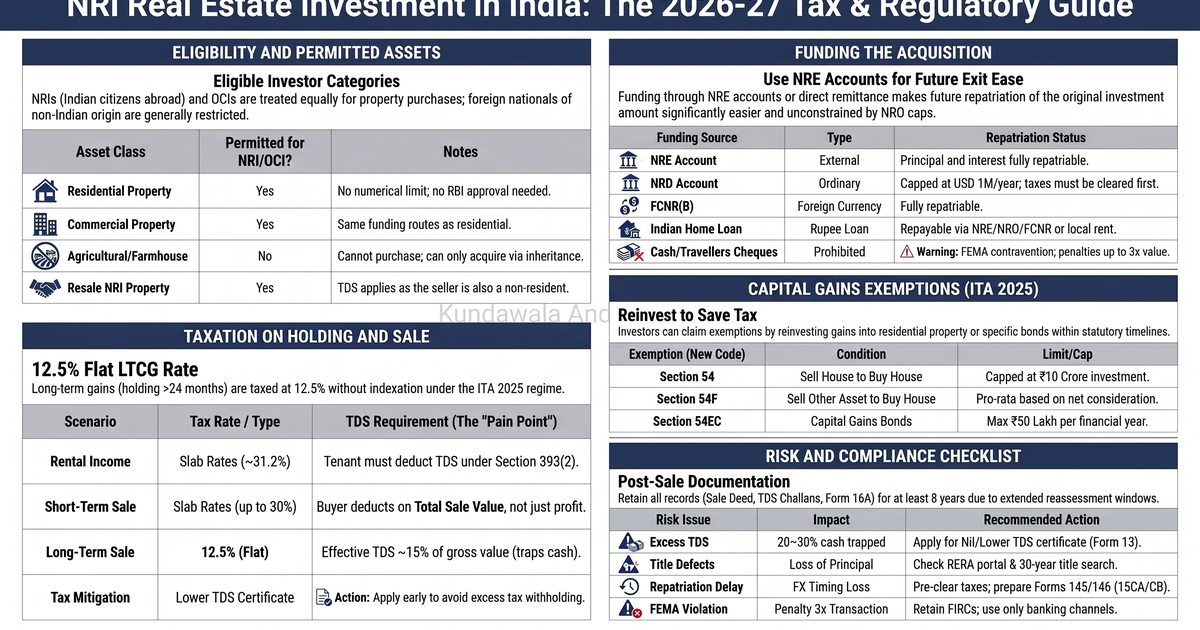
NRI Real Estate Investment in India: The 2026-27 Tax & Regulatory Guide
Buying property in India is one of the most common financial decisions NRIs make — but it sits across three separate legal frameworks: FEMA (who can buy what, and how it's funded), the new Income-tax Act, 2025 (what gets taxed, and how much is withheld), and RERA (project and title protection). Here's the full picture for Tax Year 2026-27.
Eligibility and Permitted Assets
NRIs and OCI cardholders are treated equally for property purchases in India — foreign nationals of non-Indian origin are generally restricted from direct purchase.
Asset Class Permitted for NRI/OCI? Notes
Residential property
Yes
No numerical limit; no RBI approval needed
Commercial property
Yes
Same funding routes as residential
Agricultural land / farmhouse / plantation
No
Cannot be purchased directly; can only be acquired by inheritance
Resale property from another NRI
Yes
TDS still applies, since the seller is also a non-resident
Funding the Acquisition
The purchase must be funded through normal banking channels — never cash, traveller's cheques, or foreign notes carried in by hand, which risks a FEMA contravention and a penalty of up to three times the transaction value.
Funding Source Type Repatriation Status
NRE account
External
Principal and interest fully repatriable
NRO account
Ordinary
Capped by the overall repatriation limit; taxes must be cleared first
FCNR(B)
Foreign currency
Fully repatriable
Indian home loan
Rupee loan
Repayable via NRE/NRO/FCNR funds or local rental income
Recommendation: if a future sale and repatriation is likely, fund the purchase through an NRE account or direct remittance rather than NRO — it keeps your original investment amount unconstrained by the NRO repatriation cap later.
Taxation on Holding and Sale
Scenario Tax Rate / Type TDS Requirement — the real pain point
Rental income
Slab rates (effectively ~31.2%)
Tenant must deduct TDS under Section 393(2) of the Income-tax Act, 2025
Short-term sale (held ≤ 24 months)
Slab rates, up to 30%
Buyer deducts on the total sale value, not just the profit
Long-term sale (held > 24 months)
12.5% flat, no indexation
Effective TDS runs to roughly 15% of the gross sale value, which traps cash even when actual liability is lower
Tax mitigation: apply for a lower or nil TDS deduction certificate (Form 13) well before the sale agreement is signed — this is the single most effective way to stop the buyer withholding far more than your genuine tax liability.
Capital Gains Exemptions (ITA 2025)
Investors can reduce or eliminate capital gains tax by reinvesting within the statutory timelines:
Exemption Condition Limit/Cap
Section 54
Sell a residential house, buy another residential house
Investment capped at ₹10 crore
Section 54F
Sell a non-residential asset, buy a residential house
Exemption is pro-rata to the net consideration reinvested
Section 54EC
Invest the gain in specified capital gains bonds
Capped at ₹50 lakh per financial year, with a 5-year lock-in
Risk and Compliance Checklist
Risk Issue Impact Recommended Action
Excess TDS on sale
20–30% of proceeds trapped temporarily
Apply for a nil/lower TDS certificate (Form 13) in advance
Title defects
Loss of principal
RERA portal check; 30-year title search and encumbrance certificate
Repatriation delay
FX timing loss
Pre-clear taxes; prepare Forms 145/146 (formerly 15CA/15CB) ahead of time
FEMA violation on funding
Penalty up to 3x the transaction value
Route funds only through banking channels; retain FIRCs
Post-sale documentation: retain the sale deed, TDS challans, and TDS certificates (Form 131, formerly Form 16A) for at least eight years, given the extended reassessment window under Indian tax law.
This guide is prepared for general informational purposes and reflects the rules understood to be in force as of mid-2026 under the Income-tax Act, 2025. It is not a substitute for personalised advice — always consult a qualified Chartered Accountant before acting on a specific transaction.