
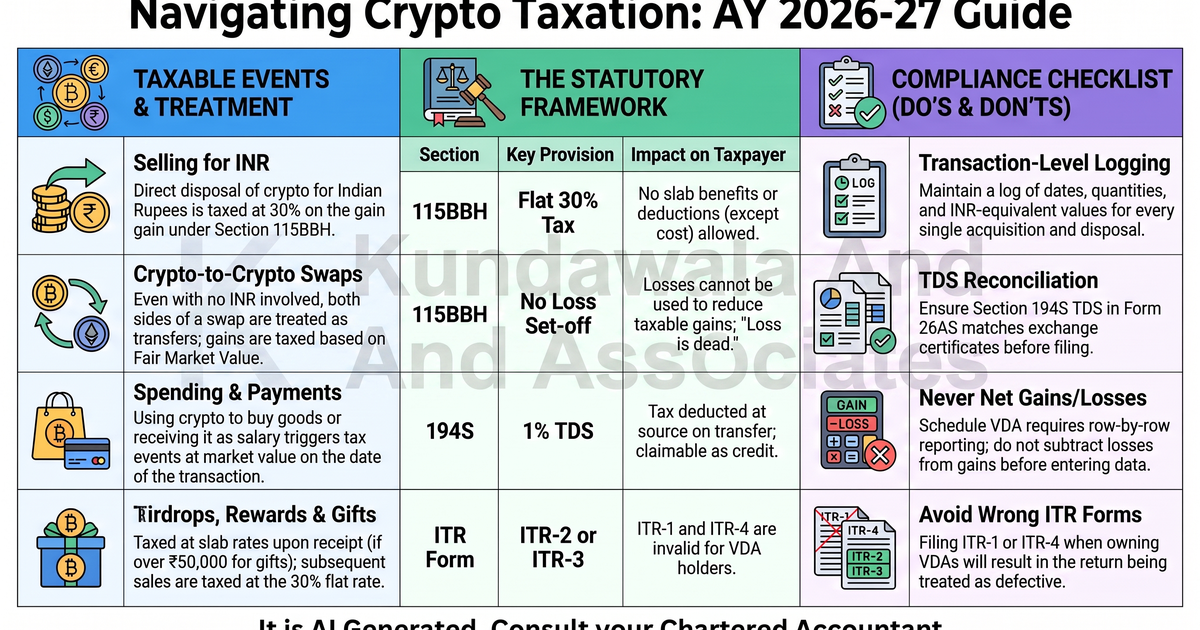
Navigating Crypto Taxation: A Complete Guide for AY 2026-27
Cryptocurrency in India isn't in a regulatory grey zone anymore — it's a clearly defined, closely tracked, and strictly taxed category of income. If you hold or trade Bitcoin, Ethereum, or any other Virtual Digital Asset (VDA), here's what you need to understand before you file your return for AY 2026-27.
Taxable Events: More Situations Trigger Tax Than You'd Expect
A common misconception is that tax applies only when you sell crypto for rupees. In reality, several distinct situations count as taxable events under the VDA framework:
Selling for INR The most straightforward case — disposing of crypto for Indian Rupees is taxed at a flat 30% on the gain under Section 115BBH.
Crypto-to-Crypto Swaps Trading one crypto asset for another — say, Bitcoin for Ethereum — is still a taxable transfer, even though no rupees change hands. The gain is computed based on the Fair Market Value of the assets exchanged.
Spending & Payments Using crypto to buy goods, or receiving it as salary or payment for services, triggers a tax event at the market value on the date of that transaction.
Airdrops, Rewards & Gifts Crypto received as an airdrop, staking reward, or gift is taxed at your applicable slab rate at the time of receipt (gifts are taxable if their value exceeds ₹50,000). Any subsequent sale of that crypto is then taxed separately at the flat 30% rate.
The Statutory Framework: What the Law Actually Says
SectionKey ProvisionImpact on Taxpayer
115BBH
Flat 30% tax
No slab benefits or deductions, except cost of acquisition
115BBH
No loss set-off
Losses on one VDA cannot reduce gains on another, or any other income
194S
1% TDS
Deducted at source on transfer; claimable as credit against final tax liability
ITR Form
ITR-2 or ITR-3
ITR-1 and ITR-4 are invalid for anyone holding VDAs
A few details are worth sitting with, because they surprise even experienced investors:
- "Loss is dead." Unlike stocks or mutual funds, a loss on one crypto trade cannot be set off against a gain on another crypto trade — let alone against salary or business income. Each transaction is taxed (or simply absorbs its loss) in isolation.
- No expense deductions. Exchange fees, gas fees, and brokerage costs are not deductible. The only permitted deduction is your original cost of acquisition.
- TDS creates a paper trail. Section 194S TDS deducted by exchanges flows into your Form 26AS and AIS — meaning the tax department already has a record of your transactions before you file.
Compliance Checklist: Do's and Don'ts
✓ Maintain transaction-level logs Keep a record of dates, quantities, and INR-equivalent values for every single acquisition and disposal — not just a summary of your net position.
✓ Reconcile TDS before filing Cross-check the Section 194S TDS reflected in Form 26AS against the certificates issued by your exchange. Mismatches here are a common trigger for scrutiny.
✗ Never net gains and losses together Schedule VDA in your ITR requires row-by-row reporting of each transaction. Subtracting losses from gains before you enter the data — even mentally — misstates your taxable income.
✗ Don't file the wrong ITR form If you hold any VDA during the year, ITR-1 and ITR-4 are not valid forms for you, regardless of how small your other income is. Filing on these forms will typically result in your return being treated as defective.
Why This Matters More Than Ever
Crypto exchanges are classified as reporting entities under PMLA, and TDS deductions under Section 194S mean your trading activity already leaves a digital trail through Form 26AS and AIS. If that data shows active VDA trading but your return has no corresponding Schedule VDA entries — or the numbers don't match — it's the kind of mismatch that draws attention quickly.
The safest approach is the simplest one: report every transaction, reconcile your TDS, use the correct ITR form, and don't try to net your losses against your gains.
Final Word
Crypto taxation in India is deliberately blunt — a flat rate, no holding-period benefits, and no relief for losses. That makes the compliance side, not the tax planning side, the place where most investors actually go wrong. Accurate, transaction-level reporting is really the only lever you have.
Not sure whether your crypto activity needs ITR-2 or ITR-3, or how to reconcile your TDS credits? Get in touch with our team — we'll help you file it correctly.
Disclaimer: This blog is AI-assisted and intended for general informational purposes only. It does not constitute professional tax advice. Please consult a qualified Chartered Accountant for guidance specific to your situation, and verify current provisions with official Income Tax Department notifications before filing.