
Input Tax Credit (ITC) is the backbone of GST — it's what keeps tax from cascading at every stage of the supply chain. But claiming ITC isn't a one-time event. If certain conditions aren't met — either at the time of claim or afterward — the law requires you to reverse that credit, often with interest. For businesses operating at scale, ITC reversal is one of the most common, and most expensive, compliance slip-ups.
Here's a breakdown of why it matters, the traps to watch for, and how to build them into your monthly compliance routine.
Why ITC Reversal Matters
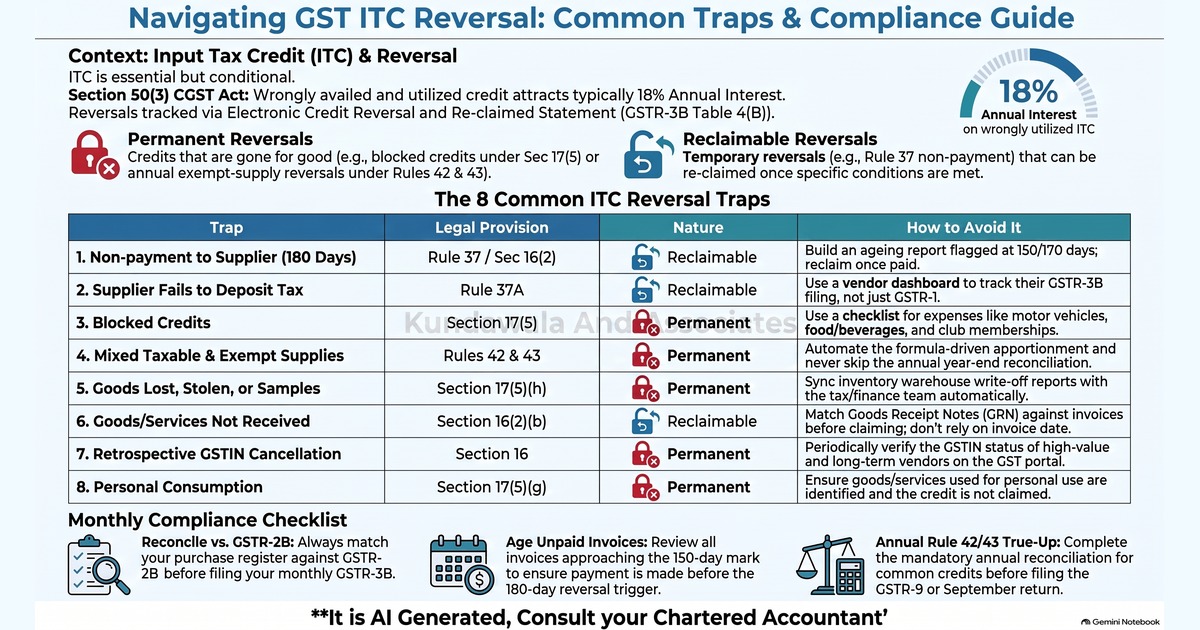
Reversal isn't just a bookkeeping adjustment. Under Section 50(3) of the CGST Act, 2017, ITC that is wrongly availed and utilized attracts interest — typically 18% per annum on the wrongly utilized credit. Beyond interest, unreconciled reversals are a leading trigger for GST notices and audits, since the department's Electronic Credit Reversal and Re-claimed Statement tracks every reversal and reclaim at a granular level in Table 4(B) of GSTR-3B, making mismatches easy to spot.
Reversals generally fall into two buckets:
- Permanent reversals — credit that's gone for good (e.g., blocked credits under Section 17(5), or annual exempt-supply reversals under Rules 42 & 43).
- Reclaimable reversals — credit reversed temporarily that can be re-claimed once conditions are met (e.g., Rule 37 non-payment reversals).
The 8 Common ITC Reversal Traps
1. Non-Payment to Supplier Within 180 Days — Rule 37 / Section 16(2) If a recipient fails to pay the supplier's invoice value (including GST) within 180 days of the invoice date, the ITC claimed must be reversed in the following month's GSTR-3B. It's reclaimable once payment is made. Avoid it: Build an invoice-ageing report flagged at 150 and 170 days, and reclaim the credit as soon as payment clears.
2. Supplier Fails to Deposit Tax — Rule 37A Even if an invoice appears in GSTR-2B, the credit becomes reversible if the supplier hasn't actually filed GSTR-3B (or paid the tax) by 30th September of the following financial year. Avoid it: Track vendor GSTR-3B filing status, not just GSTR-1, through a compliance dashboard.
3. Blocked Credits — Section 17(5) Certain categories are permanently ineligible regardless of business use: motor vehicles for personal transport, food & beverages, club memberships, works contracts for immovable property, and more. Avoid it: Maintain a blocked-credit checklist and route ambiguous expenses through a tax reviewer before claiming.
4. Mixed Taxable & Exempt Supplies — Rules 42 & 43 Where inputs, input services, or capital goods are used for both taxable and exempt supplies, the common credit must be proportionately reversed — Rule 42 for inputs/services, Rule 43 for capital goods spread over a 5-year useful life. Avoid it: Automate the monthly apportionment formula, and never skip the mandatory annual true-up before GSTR-9.
5. Goods Lost, Stolen, or Given as Free Samples — Section 17(5)(h) ITC must be reversed on inputs tied to goods that are lost, destroyed, written off, or given away as gifts or free samples. Avoid it: Sync inventory write-off and sample-dispatch reports with the tax team automatically.
6. Goods/Services Not Actually Received — Section 16(2)(b) ITC can only be claimed once goods or services are actually received — claiming on advance invoices before delivery is a common violation. Avoid it: Match Goods Receipt Notes (GRN) or service completion confirmations against invoices before claiming credit.
7. Retrospective GSTIN Cancellation — Section 16 If a supplier's registration is cancelled with retrospective effect, ITC claimed on their invoices during that period may be disallowed. Avoid it: Periodically verify the GSTIN status of high-value and long-term vendors on the GST portal — not just at onboarding.
8. Personal Consumption — Section 17(5)(g) Goods or services used for personal, non-business consumption are never eligible for ITC. Avoid it: Clearly tag personal-use expenses at the point of booking so they're excluded from the credit claim entirely.
Monthly ITC Compliance Checklist
- Reconcile the purchase register against GSTR-2B before filing GSTR-3B.
- Age all unpaid supplier invoices — flag anything nearing 150 days.
- Check vendor GSTR-3B filing status (not just GSTR-1) for Rule 37A exposure.
- Review new expense categories against the Section 17(5) blocked-credit list.
- Run the Rule 42/43 common-credit calculation for any exempt supplies.
- Sync inventory write-offs and free samples with the tax team.
- Verify supplier GSTIN status for high-value or long-term vendors.
- Complete the annual Rule 42/43 reconciliation before filing GSTR-9.
Final Word
Most ITC reversal issues aren't due to bad faith — they're due to disconnected processes: procurement doesn't talk to tax, inventory doesn't talk to finance, and vendor compliance isn't monitored in real time. Building these checks into your monthly close, rather than discovering them during an audit, is the single biggest lever for avoiding interest, penalties, and reversal-related notices.
This article is for general informational purposes and does not constitute legal or tax advice. Provisions, rates, and notifications under GST are subject to change — verify current applicability with a qualified GST practitioner or the CBIC website before relying on any specific figure or rule cited here.