
F&O Traders, Take Note: Your ITR Deadline Isn't as Simple as "31st July" This Year
If you trade in Futures & Options, tax season looks a little different for you than it does for a salaried taxpayer — and this year, the stakes of getting it wrong (or getting it late) are higher than ever.
Here's the essential guide every F&O trader should read before filing.
First, Clear Up the Deadline Confusion
Most people assume every taxpayer's ITR is due on 31st July. That's true if your income is limited to salary, interest, or capital gains. But F&O trading income is treated differently.
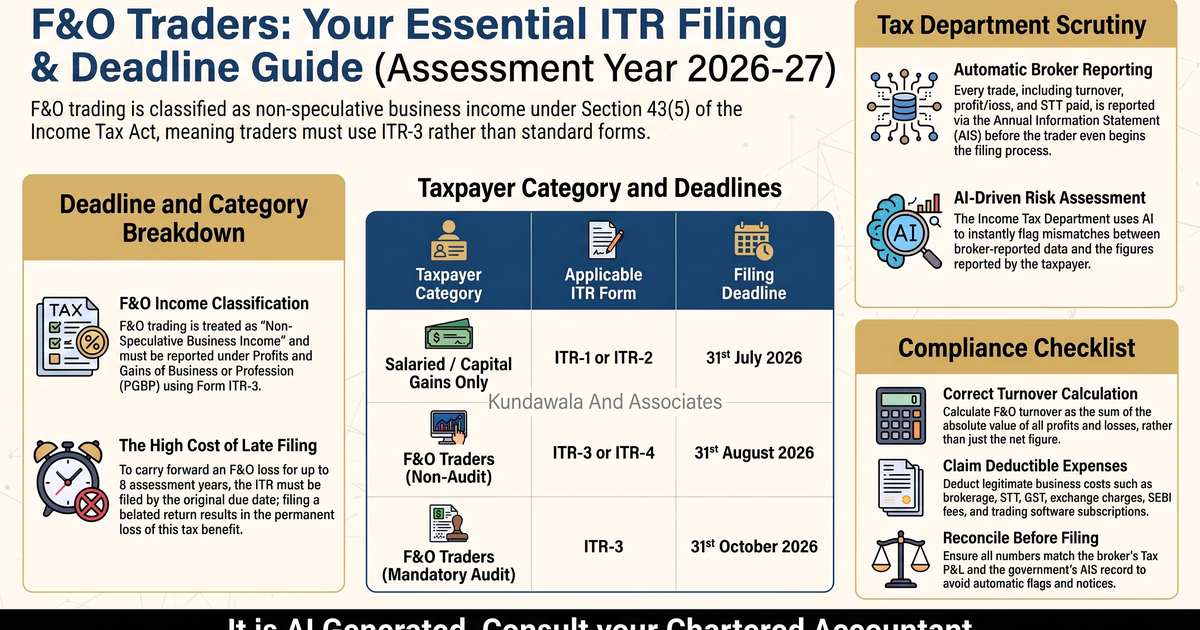
Under Section 43(5) of the Income Tax Act, F&O trading is classified as non-speculative business income, reported under "Profits and Gains of Business or Profession" (PGBP) in ITR-3 — not as capital gains. And under the Finance Act, 2026, non-audit filers of ITR-3 and ITR-4 now get an extended deadline of 31st August 2026, rather than the standard 31st July applicable to salaried taxpayers filing ITR-1 or ITR-2.
That extra month is useful — but it isn't an excuse to relax. If your F&O turnover crosses the prescribed threshold (₹10 crore, where 95%+ of transactions are digital) or certain other conditions apply, a tax audit by a Chartered Accountant becomes mandatory, and that pushes your effective deadline to 31st October 2026 — but only if the audit is actually completed and reported in time.
The bottom line: know which category you fall into, and don't assume July 31 is your date by default.
Why F&O Traders Are Under Sharper Scrutiny Than Ever
This isn't a routine filing season for derivatives traders. A few things have converged:
1. Your broker is already reporting your data. Every trade you make flows into the tax department's systems through your broker's statutory reporting and your Annual Information Statement (AIS). Your turnover, profit, loss, STT paid, and transaction dates are already on record before you even open the filing portal.
2. AI-based profiling flags mismatches instantly. The Income Tax Department's risk-assessment systems now cross-check what you report against what your broker, bank, and other data sources already show. A number that doesn't add up — a turnover figure that doesn't match your broker's P&L, or an omitted loss year — is no longer something that quietly slips through. It gets flagged, often automatically, and can trigger a notice.
3. Profit or loss, you're expected to report it. A common misconception is that F&O losses don't need to be disclosed since there's "no tax to pay." That's incorrect — and it's also the costliest mistake on this list.
The One-Day Mistake That Costs You for Years
Here is the detail that catches out even experienced traders: to carry forward an F&O loss, your ITR must be filed by the due date. Not the belated return date. Not "sometime before year-end." The original due date.
Miss it — even by a single day — and you permanently lose the right to carry that loss forward, even if your belated return is later accepted without issue. Since F&O losses can otherwise be carried forward for up to 8 assessment years and set off against future F&O or other business profits, this is a real, quantifiable cost. A trader sitting on a ₹3 lakh loss this year could be giving up close to ₹90,000 in future tax savings (at the 30% slab) simply by filing a few days late.
A Quick Compliance Checklist for F&O Traders
- Use ITR-3, not ITR-2 or ITR-4 (unless you're specifically eligible for the presumptive scheme) — filing the wrong form can invalidate your loss reporting altogether
- Calculate turnover correctly — F&O turnover is the sum of the absolute value of all profits and losses, not just the net figure
- Reconcile with your broker's tax P&L and AIS before you file, so your numbers match what's already reported to the department
- Claim your legitimate expenses — brokerage, STT, GST, exchange transaction charges, SEBI fees, and trading software subscriptions are all deductible against F&O income
- Check whether a tax audit applies to your turnover and transaction profile before assuming you're exempt
- File on time, every time — even in a loss year, even if you owe nothing, specifically to preserve your right to carry the loss forward
Final Word
Whether your F&O year ended in profit or loss, the filing itself has become a compliance exercise, not just a tax one. Broker-reported data and automated cross-checks mean small errors are caught quickly, and the cost of missing your due date — even by a day — is a benefit you can't get back.
Not sure which ITR form applies to you, or whether a tax audit is triggered by your turnover? Reach out to our team — we'll help you file it right, and on time.
Disclaimer: This blog is for informational purposes only and does not constitute professional tax advice. Due dates, thresholds, and provisions are subject to CBDT notifications and government extensions. Please consult a qualified Chartered Accountant or refer to official Income Tax Department communications for guidance specific to your situation.